
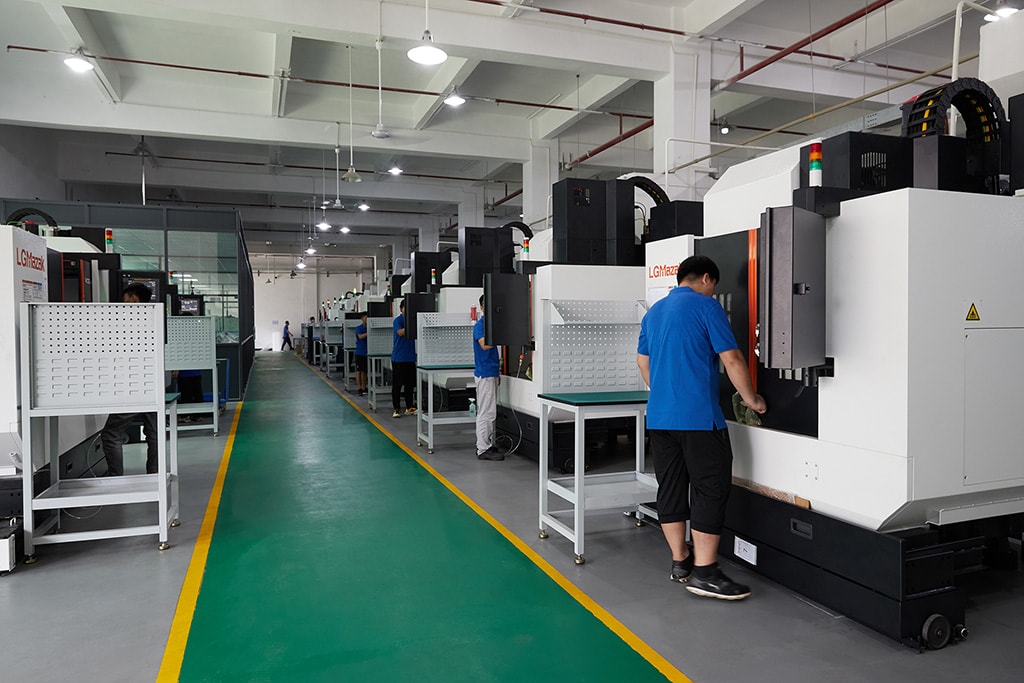
Many of the parts that go to a CNC milling service could, in principle, be made another way. The bracket could be welded from pieces, the housing die-cast, the enclosure formed from sheet metal, the prototype printed. Choosing between those routes is not a preference — it is an engineering and cost decision that depends on the geometry, the material, the volume, and the tolerances your drawing demands. It explains what machining from solid is genuinely best at, when the alternatives should win, and how to compare the finished cost per part across routes before you commit to tooling or to a process you cannot easily change.
What is CNC milling genuinely best at, and what should it not be used for?
Machining from billet or plate wins on three fronts. It holds the tightest tolerances — fit and alignment features to ±0.003 mm, with precision grinding at ±0.002 mm and process capability of Cpk 1.67 or higher on key characteristics and Cpk ≥ 1.33 on general characteristics. Capability is reported per characteristic: every report names the feature, its tolerance band, the sample size, the sigma method, and the study window. It produces parts with the documented properties of wrought material in a controlled temper, rather than the microstructure of a casting or a weld. And it carries no tooling, so one part and ten thousand parts start from the same program, and drawing changes are absorbed as program edits rather than tool rebuilds.
Those strengths define where machining should lose. When the part is produced in volumes that repay a die or a form tool, a casting or molding route will undercut the machined part on unit price. When the part is a large thin-walled box that would machine from a block of material mostly destined for the chip bin, sheet metal fabrication starts closer to the final shape. And when the geometry exists only because of another process — an internal lattice, a mold-released undercut — forcing it through a mill is wasteful. The discipline is to let the shape, the volume, and the tolerance lead, then bring machining in where it genuinely belongs: as the whole route, or as the finishing step on a near-net blank.
When should a bracket or housing be machined from one piece instead of fabricated or welded?
Fabrication is the closest competitor for many milled parts, because a bracket can be cut from plate and welded rather than carved from a block. The one-piece machined route wins when the joints themselves are the problem. A welded assembly carries a weld seam that can leak, corrode, or crack, and every joint is a tolerance story of its own — the parts distort during welding, then have to be straightened or stress-relieved, then machined again to bring the datum faces back into relationship. A one-piece machined part has none of that: the features sit where the program put them, and the datum relationships survive because nothing was joined after the fact.
The fabrication route wins when the part is a large, thin envelope with few functional features — an electronics enclosure, a cover, a light structural panel. Cutting those from solid would buy plate and mill most of it into chips; sheet metal forming produces the walls near-net, and machining only cleans up the mounting faces and holes. The decision rule is the density of machined features relative to the part size: a small part full of bores, pockets, and sealing faces is a one-piece machining job; a large empty box is a fabrication job. When the two overlap, quote both routes with the finished cost visible — weldment with its straightening and re-machining against the one-piece part — and let the numbers decide.
When does casting plus finish machining beat milling from solid?
Casting enters the decision when the shape or the volume favors a near-net start. Die casting produces aluminum and zinc housings in high volumes at cycle times that machining cannot touch, and it can form thin walls and complex exterior detail that would take hours to mill from solid. Sand casting and investment casting cover the lower volumes with simpler tooling, and they produce shapes — internal passages, cored features — that a solid block does not contain. In every case the casting is not the finished part: the datum faces, bores, threads, and sealing surfaces still need machining to the tolerance the drawing demands, which is why the practical route is cast-then-machined.
The crossover is not a fixed number; it is wherever the tooling, divided by the parts you will actually buy, drops below the machining premium that the blank removes. On a large thin housing in aluminum, a sand-cast blank can pay back at a few hundred parts because the material saving is enormous; on a small dense bracket, solid machining wins until the volume is very high. Compare the finished cost — casting tooling on its own line, casting unit price, plus the finish machining — against solid machining at your real quantity, and add the revision cost: a design change after the tool is cut is money and weeks, while a machined part absorbs it as a program change. While the design is still moving, the solid route is the flexible one.
When does 3D printing beat milling for prototypes and low volumes, and where does it lose?
Additive manufacturing is the fastest route to a physical part, and that alone earns it a place in the decision for prototypes and early iterations. When the purpose of the part is to check fit, assembly, or ergonomics, a printed part delivers that answer in days without tooling and without committing to a material block. For low-volume parts whose geometry is additive-native — internal channels, lattices, shapes a mold cannot release — printing can also beat machining on cost, because the alternative is an assembly of machined pieces or a process that wastes most of an expensive block.
Printing loses wherever the drawing takes a tolerance or finish seriously. A printed surface carries layer steps, so there is no natural machined surface and no roundness in the printed state; printed dimensional scatter sits in tenths of a millimetre, which no tight callout accepts without post-processing. The pattern that works is hybrid: print or cast the near-net shape, leave stock on the faces that must be precise, and machine those faces to the tolerance and finish the drawing demands. When you evaluate a printed prototype against a milled first article, be clear about what the prototype must prove — if it is tolerance or performance, it must be machined in the production material, because a printed part will not behave like a milled one.
Which material choice tilts the process decision for a milled part?
Material and process are decided together, because the useful materials do not all exist in every form. A machined housing is specified in a wrought grade — 6061-T6 or -T651 aluminum, 7075 where the loads are higher — cut from plate or billet with documented properties. A cast housing is specified in a casting grade whose flow and fill behavior suit the mold, and its properties are certified for the cast condition. Mixing the two is a specification error: asking for 6061-T6 in a die casting makes no sense, and substituting a casting grade into a machined-from-plate drawing changes the mechanical story. The drawing, the material certificate, and the process have to agree.
Material choice also moves the economics of the process decision. On aluminum, the material bill for a machined part is usually modest, so solid machining stays competitive across a wide range. On titanium and nickel, the raw material dominates, and a part that machines from a block most of which becomes chips becomes a candidate for a near-net blank even at modest volume. On plastics, the decision changes again: machined engineering plastics need no tooling and hold tight tolerances, while molded plastics amortize a mold. When you compare processes, put the material in its form — plate, billet, casting alloy, or molding grade — because the form is half of the cost story.
Sheet metal and machining, or a one-piece machined enclosure: how do you decide?
The enclosure decision is the practical version of the material-process trade most buyers meet early. A one-piece machined enclosure from 6061 plate gives you solid walls, clean cosmetic surfaces, tapped holes in solid metal, and EMI and sealing properties that a fabricated box cannot match, but you buy a block and machine away most of it, which is why machined enclosures are priced by the amount of material removed. A sheet metal enclosure, formed and welded or folded from thin sheet, starts near its final shape and wins on material cost and weight at larger sizes, but its walls are thin, its tapped holes need inserts or PEM hardware, and its flatness and sealing are harder to control.
The deciding variables are size, quantity, and function. A small dense enclosure full of mounting bosses and connectors is a machining part. A large panel with few features is a sheet metal part. In between, quote both: the machined route itemizes material and machine time, the sheet metal route itemizes forming, welding, hardware, and any post-machining of the mounting faces. Add the design-maturity factor — a machined enclosure changes cheaply as the design evolves, while sheet metal tooling for bends and forms is a smaller but real commitment. For most product teams early in a program, the machined enclosure is the lower-risk place to be.
How do tolerance, finish, and internal geometry filter the alternatives?
Tolerance is the filter that settles most arguments, because it is the requirement that cannot be negotiated. Casting, forming, and printing produce near-net shapes measured in tenths of a millimetre; machining holds fit and alignment features to ±0.003 mm, and precision grinding reaches ±0.002 mm, with Cpk of 1.67 or higher on key characteristics and Cpk ≥ 1.33 on general characteristics. Capability is reported per characteristic: every report names the feature, its tolerance band, the sample size, the sigma method, and the study window. Any part whose drawing carries the tight band on a bore, a mounting face, or a profile must pass through machining at the end of its route, no matter where the shape starts. The process decision is therefore not machining versus casting — it is how much of the part machining must produce from solid versus finish from a blank.
Finish filters the same way, and internal geometry filters hardest of all. A sealing face at a controlled Ra, a bearing bore with a roundness callout, a datum face that locates an assembly — these are machined features by definition. And when the drawing contains an internal passage or a cored cavity, the geometry itself decides the route: a passage that no tool can reach is a casting or a printed feature, and the machined faces around it are the parts the milling service produces. Put your tolerance, finish, and internal-feature list next to each process's realistic output before you request quotes. The filter will point most parts toward the route they were going to take anyway, and save you the cost of discovering a mismatch at first article.
How do you compare total cost across these routes when sourcing from China?
Compare finished parts at your real quantity, with every element visible. The quote structure should separate material, machining, tooling (where it exists), secondary operations such as anodizing or heat treatment, inspection, and freight — a supplier that hides tooling in the unit price is hiding the crossover where a near-net route would win. Put the material in its form, because the form decides how much material you buy: solid machining buys a block and cuts chips, while a casting or a sheet metal blank starts closer to the shape. On a thin large part the material saving can outweigh the tooling cost; on a small dense part it rarely does.
Then add the two costs that never appear on a quote: qualification and revision. A new die, mold, or forming tool has a first-article cycle and a qualification burden that a machined part does not, and switching routes later costs new tooling, a new first article, and re-approval. When the numbers are on the table, ask the supplier for the honest recommendation — a milling service worth keeping will tell you when casting or fabrication is the cheaper route, because that honesty is what brings the rest of your work back. The services page on this site explains how milling, finishing, and heat treatment are combined into a route, and the FAQs cover the tolerances, materials, and documentation questions that come up when you compare processes.
Frequently Asked Questions
When should a housing be machined from one piece instead of fabricated from sheet metal?
Machine it from one piece when it is small enough that billet stock is affordable, when internal features need machined accuracy, or when the housing carries sealing faces and bores a welded box cannot hold. Fabricated sheet metal wins when the envelope is large, the walls are thin, and the functional features are few. The density of machined features relative to size is the dividing line.
When does a cast-and-machined part beat machining from solid?
When tooling amortizes over enough parts or the material saving is large enough. A die-cast housing pays back at higher volume; a sand-cast blank can win at a few hundred parts if the part is large and thin. The blank still needs machining for datums, bores, and threads, so compare the finished cost at your real quantity.
Can a 3D-printed prototype replace a milled first article?
For a pure fit and assembly check, often yes. For a part that must validate tolerances, finish, or material behavior, no — printed parts carry layer steps and dimensional scatter that milled parts do not. When the prototype must prove performance, machine it in the production material.
Is a welded fabrication always cheaper than machining the same assembly from one piece?
Not always. Fabrication trades machining time for welding, distortion, and joint risk — every weld is a potential leak path. One-piece machining removes the joints and holds datum relationships a weldment cannot. Price the finished weldment, including straightening and re-machining, against the one-piece part at your quantity.
Which aluminum should I use for a machined enclosure versus a cast one?
A machined enclosure is usually 6061-T6 or -T651 plate with wrought properties and clean surfaces; a cast enclosure uses a casting grade whose properties are certified for the cast condition. Do not substitute one for the other — the material callout and the process have to agree or the certificate will not match the design intent.
What tolerance can each process deliver on a housing or bracket?
Casting, fabrication, and printing work in tenths of a millimetre. Machining holds fit and alignment features to ±0.003 mm, precision grinding reaches ±0.002 mm, and Cpk of 1.67 or higher is demonstrated on key characteristics. Where the tight band rules, machining is mandatory and the other processes feed it a blank.
If my design is still changing, which route should I use?
Machine it. A machined part absorbs a drawing revision as a program change and a first-article run; a die, mold, or forming tool change is money and weeks. While the geometry is moving, billet machining keeps you flexible, and it is usually the cheapest route at the low volumes a moving design implies.
Not sure whether your part should be machined, cast, fabricated, or printed?
Email [email protected] or call +86 13126536955 for an honest process comparison — including the routes where machining is not the cheapest answer.